


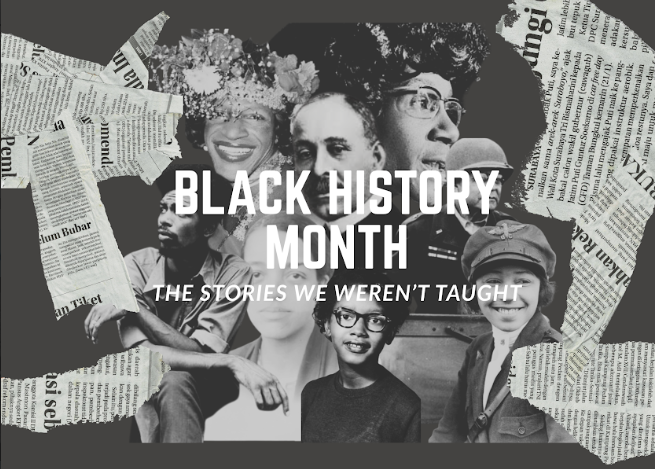
Who are the first three people you think of when you hear “Black History Month”? I’m assuming most of you thought of Martin Luther King Jr., Rosa Parks, and Barack Obama. Or maybe you thought of Harriet Tubman, Madame C.J. Walker, and Malcom X. I don’t think very many of you would’ve thought of Claudette Colvin, the first black woman to refuse to sit at the back of the bus even before Rosa Parks, or Gil Scott-Heron, known as the godfather of rap music. But, I will give you the benefit of the doubt. I want to shine a light on some of these people, people who don’t deserve for their hard work and their stories to be erased. Starting with: Shirley Chisholm, the first Black woman to obtain a seat in Congress.
Shirley Chisholm was born on Nov. 30, 1924, and was the eldest of four daughters. Her parents, Charles St. Hill and Ruby Seale St. Hill were immigrants. She grew up in New York and graduated from Brooklyn Girls’ High in 1942, then later from Brooklyn College in 1946. Her professors encouraged her to go into a political career, but Chisholm replied that she faced a “double handicap”–being Black and a woman.
She earned a Masters degree in early childhood education from Columbia University in 1951 and worked as a nursery school teacher. She then joined local organizations advocating for the suffrage movement and people of color (League of Women Votes, the National Association for the Advancement of Colored People [NAACP], the Urban League, and the Democratic Party club).
In 1964, she ran for and became the first African American in the New York State Legislature. Four years later, she won a seat in Congress. She was known as “Fighting Shirley”, and fought for racial and gender equality, introducing more than 50 pieces of legislation advocating for this. She co-founded the National Women’s Political Caucus in 1971 and six years later became the first Black woman and the second woman to serve on the House Rules Committee. Chisholm died on Jan. 1, 2005. Her hard work paved the way for other women and Black women alike to strive for greatness and represent their communities politically. On the subject of her legacy, Chisholm said: “I want to be remembered as a woman…who dared to be a catalyst of change.”
Benjamin O. Davis, Sr. was the first Black general in the U.S. armed forces. He has two known possible dates of birth: July 1, 1877, the date he gave when enlisting for the military, and May 28, 1880, which is believed to be his real date of birth. He was born to Louis P.H and Henrietta Davis. His grandparents had been enslaved before the 13th amendment abolished slavery. He learned about the army during his time in the cadet program at his school, M Street High School in Washington. During his senior year in 1898, he decided to enlist in the military. Davis, Sr. served as a volunteer in the Spanish-American War, and later re-enlisted as a private in the 9th Cavalry; the 9th Cavalry was one of the U.S Army’s segregated Buffalo Soldier regiments. There, he rose to the title of sergeant major within two years, and earned his commission as a second lieutenant in 1901.
For the next four decades, Davis, Sr. served in Liberia and the Philippines, as well as teaching military science at Tuskegee and Wilberforce University, respectively. The article “Benjamin O. Davis, Sr,: Accomplishments, & Biography” by the Britannica said: “All of his duty assignments were designed to avoid a situation in which Davis might be put in command of white troops or officers.” In 1930, he became the first Black colonel, and was promoted to brigadier general by President Franklin D. Roosevelt a decade later.
During World War II, he headed a special unit and was in charge of safeguarding the status and morale of Black soldiers in the army. After 50 years of service, he retired in 1948. Davis, Sr. changed how the world viewed Black soldiers. He pushed against racial boundaries and was a catalyst for huge changes. President Roosevelt went on to issue two executive orders ending racial discrimination in the U.S. defensive industry and armed forces. He made the army a more inclusive space and set a new standard for Black soldiers in the army.
Marsha P. Johnson was a Black trans woman who was one of the biggest activists for LGBTQ+ rights in the 1960s and 1970s. She was born male on Aug. 24, 1945, but enjoyed wearing clothing made for girls. After graduating high school from Thomas A. Edison High School, she moved to New York City with only $15 and a bag of clothes. Once there, she changed her name to Marsha P. Johnson, the “P” standing for “Pay It No Mind”, her life motto and response to any questions about her gender.
Marsha spent most of her life without a permanent home, and “hustled” (worked as a sex worker) for money. This work was incredibly dangerous; oftentimes she had a gun pointed at her and once, she was shot. At 17, she met 11 year old Sylvia Rivera, a Puerto Rican trans woman looking to start a new life in New York. On June 28, 1969, she took part in the Stonewall uprising. That night, police officers raided a gay bar, and the patrons fought back. It is unclear how the rebellion started, but historians seem to agree that Marsha was the catalyst.
After that, she attended rallies, sit-ins, and meetings of the Gay Liberation Front where she advocated not only for gay and lesbian rights, but for trans rights and colored people’s rights. In 1970, Marsha and Sylvia found the Street Transvestite* Activist Revolutionaries (STAR), an organization dedicated to giving trans people a home so they didn’t have to live on the streets. (While it was in use during Marsha’s life, this term is now considered offensive and has been replaced with other terminology, such as transgender.)Although organizers of gay pride parades attempted to ban STAR from attending, that didn’t stop them from fighting for trans rights. Marsha was arrested over 100 times and was known as “Saint Marsha” in Greenwich Village.
Tragically, on July 6, 1992, her body was found in the Hudson River. Police ruled it as suicide and never investigated into her death. The case was reopened in 2012, but remains unsolved to this day. So, why is Marsha P. Johnson not widely recognized for her role in the LGBTQ+ liberation movement? The answer is simple: because she was Black and a woman, a trans woman, no less. It’s bad enough that history doesn’t like to recognize women for their contributions to society, but there is enough stigma around the transgender community that there’s no real question as to why Marsha isn’t a big name. This is unfair to her, and to her legacy. Marsha P. Johnson helped pave the way for future generations to give trans rights more attention, and specifically Black trans rights.
Daniel Hale Williams was the first African American physician to perform a successful open-heart surgery. He was born on Jan. 18, 1856. Some sources say he was the fifth of seven children, others say he was the eldest of eight. When he was young, his father died of tuberculosis. He began working as a shoemaker, but knew that he wanted more education. At age 20, he began working under Dr. Henry Palmer, a former surgeon general for Wisconsin. He studied medicine at Chicago Medical College and began teaching anatomy there shortly after.
In 1889, the governor of Illinois appointed him to the state’s board of health. He used his position to advocate for a hospital open to all races; Williams opened Provident Hospital and Training School for Nurses on May 4, 1891, which was the country’s first interracial hospital and nursing school. In 1893, a man came to his hospital after being stabbed in the chest. Williams performed the world’s first successful open heart surgery that day, and the landmark was hailed in the press. One year later, he became the chief surgeon of Freedman’s Hospital in Washington D.C., which was the most prestigious medical post available for African Americans at the time. While there, he made improvements that lowered the hospital’s mortality rate.
In 1895, he organized the National Medical Association for Black Professionals, who were not allowed on the American Medical Association. In 1913, he became the first African American to be inducted into the American College of Surgeons. Dr. Williams’s work and advocacy for Black rights and presence in medicine is honored by universities and schools worldwide, and he is often used as inspiration for younger generations of African American doctors. He made space for people of color to pursue medicine and gain more respect in their field.


